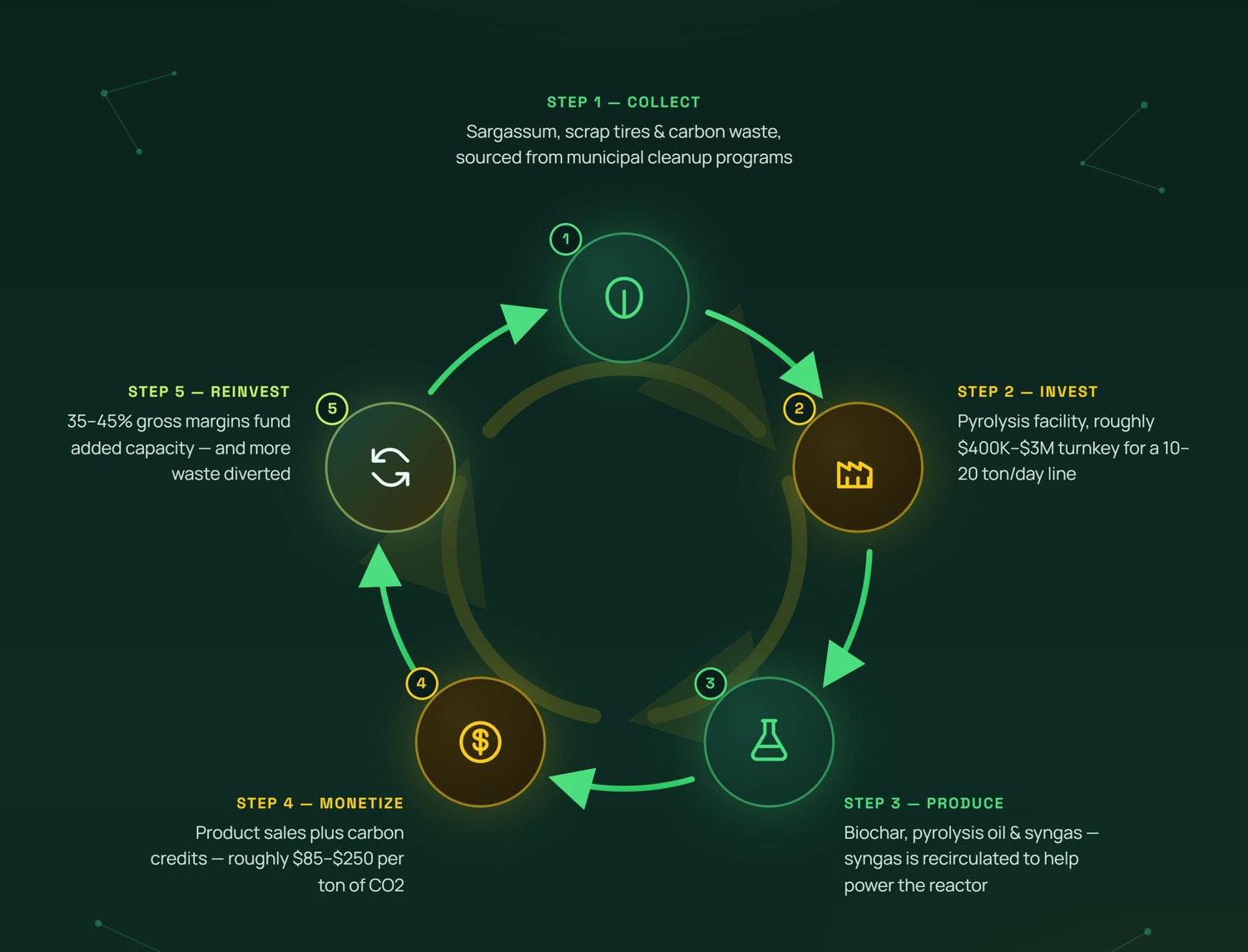
We don't just remove sargassum, we transform it. Through pyrolysis, intercepted seaweed becomes biochar, a durable carbon sink and clean-energy resource, turning a coastal crisis into a circular, green outcome.
Pyrolysis heats sargassum in a sealed, oxygen-free thermal process. Instead of rotting on a beach and releasing methane, the biomass is converted into three valuable streams, biochar, bio-oil, and syngas, with the process gas recirculated to power the thermal process itself.
The star product is biochar: a stable, carbon-rich solid that locks carbon away for centuries. It carries an energy value higher than low-grade coal, can serve as a clean fuel or a water-treatment material, and earns durable carbon-removal credits. Together with the electricity the process can return to the grid and the green credits from other waste it can accept, that is three independent climate wins from a single operation.
The result is a coastline protected, an economy defended, and a genuine contribution to the green-energy transition, all from a resource that was previously treated as waste.
Eight steps take sargassum from collection, on land or out at sea, all the way to a durable, useful biochar.
The conversion technology at the heart of SeaSmart, and the reason a single operation can earn three carbon wins.
Pyrolysis uses thermal decomposition in an oxygen-limited environment to break material down without burning it. For sargassum, that yields biochar, bio-oil, and syngas, with the process gas recirculated to help power the thermal process.
The same process is feedstock-flexible. It is designed to accept other once-biomass and hard-to-recycle waste streams, which is where our third carbon win, green credits, comes from. The technology is not new, but recent process improvements have raised product consistency and addressed the operational-stability issues that limited earlier commercial systems.
In the recycling sector, pyrolysis is the chemical-processing route attracting the most serious commercial investment. It is best understood as a complement to mechanical processing, handling what mechanical processing cannot economically upgrade: fine fractions, contaminated materials, and processing residues.
Planning equipment with pyrolysis integration in mind gives an operation far more flexibility than treating it as a separate, future decision.
End-of-life tires are one of the biggest hard-to-recycle waste streams in the United States, and a natural candidate for our pyrolysis platform. Tire pyrolysis recovers carbon black, tire-derived fuel oil, steel, and syngas, distinct from the biochar we make from sargassum. SeaSmart's process is designed to accept feedstocks like these as it scales, turning waste that would otherwise be burned or stockpiled into recovered value and green credits.
Source: Gradeall, US Tire Recycling Facts & Statistics. Nearly half of recovered tires are simply burned as fuel, value that pyrolysis can capture instead.
Advanced polymer separation is advancing too. Research programs are identifying ways to recover specific rubber-compound fractions for higher-value uses than bulk crumb rubber. This is still mainly at the applied-research stage, but the commercial trajectory points toward increasingly differentiated recovered products within five to ten years, another reason to build with pyrolysis integration in mind today.
The process runs on its own syngas, and the biochar is a coal-beating solid fuel, energy recovered from what was waste.
Biochar locks carbon away for 200+ years and earns durable carbon-removal credits, alongside electricity returned to the grid and green credits from other waste.
Nothing is landfilled. A coastal nuisance becomes fuel, carbon, and clean-water materials, protecting tourism and reefs.